
For decades, IT has been the engine room of the enterprise—keeping systems running, networks secure, and data available. But in today’s business environment, that’s no longer enough. Technology now defines how organizations compete, deliver value, and engage with customers. The once-clear boundary between “the business” and “IT” has blurred, and survival increasingly depends on how effectively an organization integrates technology into its DNA.
The Limits of Traditional IT
Traditional IT has long been measured by stability, cost control, and operational efficiency. Those are still vital, but they no longer differentiate. Every competitor now has access to the same cloud platforms, cybersecurity tools, collaboration suites, and analytics engines. The cost barrier that once separated the technological “haves” from the “have-nots” has nearly vanished.
This democratization of technology has leveled the playing field—and in many ways, it has inverted it. Small startups can now disrupt entire industries with the same capabilities that once took large corporations many years and millions of dollars to build. In this new reality, the question isn’t whether an organization can get technology; it’s whether it can utilize technology more effectively than anyone else.
That’s where the IT vision shift becomes critical. As shown in the figure below, leading organizations are evolving from Traditional IT—focused on process, control, and internal operations—to Business-Focused IT, where the mission is driving business growth, innovation, and customer value. The shift is not just semantic. It redefines IT’s identity from a reactive service provider to a proactive, strategic enabler of the business.
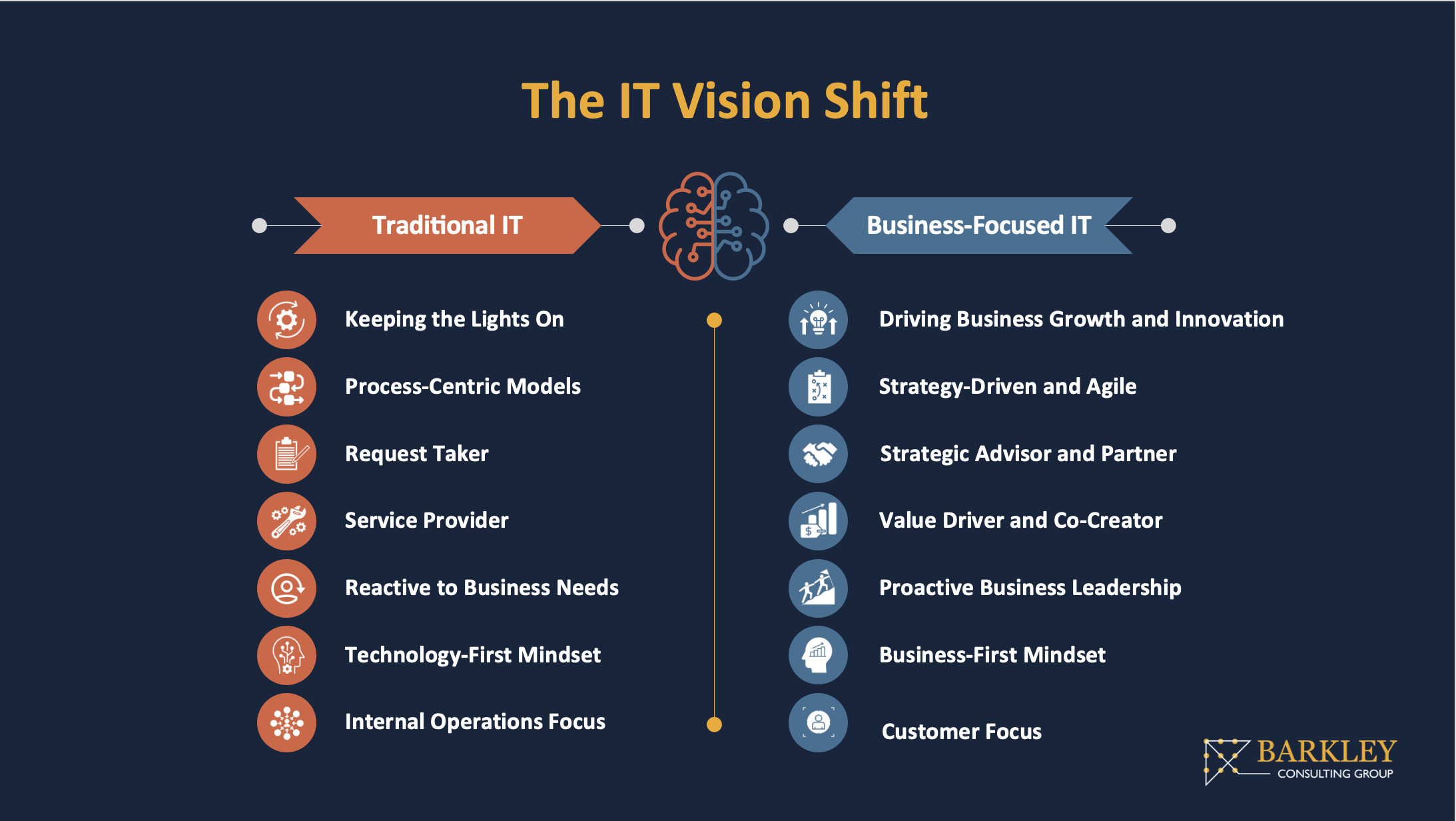
The IT Vision Shift (Downloadable)
Why IT Must Become a Force Within the Organization
IT can no longer simply respond to business requests: It must anticipate needs, shape conversations, and help chart the organization’s direction. That means developing a deep understanding of the business model, customer journey, and strategic goals—and then translating them into technology-enabled outcomes.
Consider the current wave of Artificial Intelligence adoption. Every boardroom is talking about it. Executives are eager to “do something with AI,” but without the proper context and governance, enthusiasm often outpaces readiness. As Mark Twain famously said, “It’s not what you don’t know that hurts you—it’s what you know for sure that just ain’t so.” Many organizations “know” AI will transform their business, but few understand how it should be applied, where it will create the most value, or when the timing is right.
This is where IT leadership must step up—not by acting alone but by leading in partnership. A truly business-focused IT organization doesn’t just implement AI models or purchase automation tools; it works with business leaders to navigate the complexity of opportunity. IT brings a deep understanding of the technology, the organization’s internal capabilities, and the guardrails needed for responsible adoption. Business leaders bring market insight, strategic priorities, and customer perspective. Together, they evaluate where AI can augment customer experience, optimize operations, and create competitive advantage—ensuring that those efforts are aligned with real business priorities, capabilities, and ethical boundaries.
Technology as the New Battlefield
In this hypercompetitive era, an organization’s ability to leverage technology effectively is directly tied to its ability to survive. Companies that cling to old models of IT governance—where technology waits for the business to issue requests—will find themselves perpetually a step behind. Meanwhile, competitors that have built integrated business-technology partnerships will seize market share, driven by faster innovation cycles and a clearer sense of shared purpose.
Being business-focused means IT is not only fluent in technology but also conversant in the language of business outcomes: revenue growth, margin improvement, customer loyalty, risk management, and employee experience. The transformation requires new mindsets, new operating models, and above all, new relationships.
How BRM Bridges the Gap
This is where Business Relationship Management (BRM) comes in. BRM provides the framework, capability, and mindset that allow IT to connect meaningfully with the business— ensuring that technology investments are strategic, aligned, and value-driven. It turns transactional interactions into trusted partnerships.
BRMs act as translators between business opportunity and technological possibility. They help business leaders articulate needs in terms of desired outcomes rather than solutions, and they assist IT leaders in designing solutions that create measurable value. In doing so, they close the persistent trust gap that has plagued IT for years—the perception that IT “doesn’t get” the business, or that it’s too slow, too rigid, or too inwardly focused.
When BRM is embedded into the DNA of IT the organization gains a new kind of agility—one grounded not in speed alone, but in alignment. Decisions become faster because priorities are clearer. Innovation becomes more sustainable because it is built on genuine partnership. And value becomes more visible because it is measured and communicated in business terms.
The Road Ahead
As technology becomes more pervasive, the distinction between “business strategy” and “technology strategy” is disappearing. The organizations that thrive will be those that fuse the two, where IT leaders and business leaders share a single vision of success.
In that fusion, BRM is not an optional capability. It’s the connective tissue holding the business-technology partnership together. BRM ensures that as IT evolves from “keeping the lights on” to “driving business growth and innovation,” it does so with credibility, clarity, and trust.
Ultimately, the business-focused IT organization cannot exist without BRM. It is the discipline that makes collaboration possible, the compass that keeps innovation aligned with strategy, and the mechanism that transforms technology from a cost to a catalyst. In a world where technology parity has erased traditional advantages, it may be the most critical capability an IT organization can build—and perhaps the one that determines its very survival.
About the Author
Jeff Warren is the President of Barkley Consulting Group, a leading BRM consulting firm that helps IT organizations build effective BRM programs, develop high-performing talent, and strengthen business partnerships to deliver measurable value. A former IT executive with over 35 years of leadership experience, Jeff is recognized for bridging business and technology to drive organizational success.